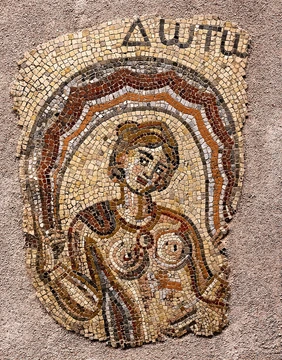
Tyro
Elean princess, queen of Iolcus, mother of heroes.
Tyro was an Elean princess in Greek mythology who later became Queen of Iolcus. She is known for her unions with both the god Poseidon and her uncle King Cretheus, and as the grandmother of Jason, the leader of the Argonauts.
- field
- Greek mythology
- nationality
- Elean (Greek)
- known_for
- Mother of Pelias and Neleus by Poseidon; grandmother of Jason
- family
- Daughter of King Salmoneus and Alcidice; wife of Cretheus, later Sisyphus
Lore & Background
Tyro was the daughter of King Salmoneus of Elis and Alcidice, daughter of King Aleus of Arcadia. She married her uncle King Cretheus of Iolcus and bore him three sons: Aeson, Pheres, and Amythaon. She also bore twin sons, Pelias and Neleus, with the god Poseidon, who had disguised himself as the river god Enipeus, whom Tyro loved. Tyro exposed the twins on a mountain, but a herdsman found and raised them. When the twins reached adulthood, they found Tyro and killed her stepmother Sidero for mistreating Tyro. Sidero had hidden in the temple of Hera, but Pelias killed her there, earning Hera's undying hatred and her subsequent patronage of Jason and the Argonauts.
Reader's Guide
Tyro's significance in Greek mythology lies in her role as a matriarch linking several major heroic lineages. Through her son Aeson, she became the grandmother of Jason, the central figure of the Argonautic quest for the Golden Fleece. Her twin sons by Poseidon, Pelias and Neleus, became kings—Pelias of Iolcus and Neleus of Pylos—and Pelias's murder of Sidero in Hera's temple directly motivated the goddess's support for Jason. Tyro's later marriage to her paternal uncle Sisyphus and her killing of their children to protect her father Salmoneus from a prophecy adds a darker dimension to her story. Her myth appears in works by Homer, Hesiod, and later poets, and Ezra Pound referenced her rape by Poseidon in The Cantos, as well as her eventual liberation from the underworld. Tyro thus embodies themes of divine intervention, familial conflict, and the tragic consequences of prophecy.
Did You Know?
- Tyro bore twin sons, Pelias and Neleus, to Poseidon after he disguised himself as the river god Enipeus.
- Her son Pelias killed her stepmother Sidero in the temple of Hera, earning the goddess's hatred.
- Tyro later married her paternal uncle Sisyphus and killed their children to prevent a prophecy that they would kill her father Salmoneus.
- In some accounts, Tyro had a daughter named Phalanna, who gave her name to the city of Phalanna in Thessaly.
Frequently Asked Questions
Who is Tyro in Greek mythology?
Tyro was an Elean princess, daughter of King Salmoneus and Alcidice, who became Queen of Iolcus through her marriage to her uncle Cretheus. She is best known as the mother of the twin brothers Pelias and Neleus, whom she bore in a secret union with Poseidon.
What is Tyro's role in the broader mythological narrative?
Tyro functions as the generational pivot linking the house of Iolcus to the Argonaut legend, since her granddaughter's husband is the hero Jason. Her dual paternity of Pelias and Neleus—one fathered by Poseidon, the other by Cretheus—seeds the sibling rivalry that drives much of the Iolcus storyline.
How does Tyro's story end?
Most surviving accounts place Tyro's death in Iolcus, where she outlives the early political struggles between her sons. A few later traditions add that she eventually married Sisyphus, though details of her final years remain inconsistent across sources.
Why is Tyro relevant to discussions of filicide and family violence in myth?
The household Tyro built at Iolcus becomes the setting for cycles of betrayal, exile, and lethal conflict among her descendants, making her lineage a recurring backdrop for stories of children turned against one another. Scholars of mythic family violence often trace the Iolcus feud back to the ambiguous parentage she established.
What divine connection does Tyro have?
Her most significant divine link is her night with Poseidon, who took the form of her husband Cretheus to father Pelias and Neleus. This secret union ties the royal line of Iolcus directly to the sea god and gives her sons a claim to divine ancestry that shapes their ambitions.
More in Filicide in mythology 1-24
Spotted an error? Know more?
This is a living reference — every entry is fact-audited, and reader corrections feed straight into our audit queue. Suggest an edit · See this site's audit record