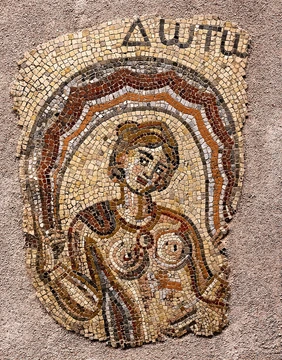
Aeolus (son of Hellen)
Eponym of the Aeolians and progenitor of Greek heroes.

Wikipedia / Wikimedia Commons
Aeolus (or Aiolos) was, in Greek mythology, the son of Hellen, the ruler of Aeolia (later called Thessaly), and the eponym of the Aeolians, one of the four main tribes of the Greeks. He was a central figure in myths about the origins of the Greek people, being the grandson of Deucalion, the survivor of a great primordial flood. From Aeolus sprang most of the heroes and heroines of the Deucalionids.
- father
- Hellen
- mother
- Othreis (according to Hellanicus) or Orseis (according to Apollodorus); both names may be corruptions of Othyis
- spouse
- Enarete, daughter of Deimachus
- children
- Seven sons (Cretheus, Sisyphus, Athamas, Salmoneus, Deion, Magnes, Perieres) and five daughters (Canace, Alcyone, Pisidice, Calyce, Perimede)
- known_for
- Eponym of the Aeolians; progenitor of many heroes and heroines; sometimes confused with the Aeolus who was ruler of the winds
Lore & Background
Aeolus was one of the central figures in myths about the origins of the Greek people. He was the grandson of Deucalion, the son of Prometheus, though it was Deucalion himself who survived a great primordial flood. From Deucalion and his wife Pyrrha sprang a new race of people, and their son Hellen became the eponym of the Hellenes. Hellen had three sons: Dorus, Xuthus, and Aeolus. Dorus was the eponym of the Dorians, Xuthus's sons Achaeus and Ion were the eponyms of the Achaeans and Ionians, and Aeolus was the eponym of the Aeolians. According to the Hesiodic Catalogue of Women, most if not all of the heroes and heroines of the Deucalionids sprang from Aeolus.
According to Apollodorus, Aeolus married Enarete, daughter of Deimachus, and had seven sons and five daughters. The sons were Cretheus, Sisyphus, Athamas, Salmoneus, Deion, Magnes, and Perieres; the daughters were Canace, Alcyone, Pisidice, Calyce, and Perimede. The Hesiodic Catalogue also listed seven sons and five daughters, though only some names are preserved. Other sources give other children by other mothers, including Melanippe by Hippe, and Macareus. Note: The story of Canace's forced suicide for incest with Macareus is often misattributed to this Aeolus; in standard myth, that tale involves the wind god Aeolus, not the son of Hellen.
Apart from being a progenitor, Aeolus himself was of little mythological note. He played a role in one myth involving Hippe, daughter of the Centaur Cheiron. Aeolus seduced Hippe, producing a daughter Melanippe. When Hippe was about to give birth and be discovered by her father, she prayed to the gods and was transformed into a horse and placed among the stars, becoming the constellation 'the Horse' (modern Pegasus). This Aeolus was sometimes confused with the Aeolus who was the keeper of the winds encountered by Odysseus in Homer's Odyssey.
Reader's Guide
Aeolus (son of Hellen) holds significance primarily as an eponymous ancestor and genealogical linchpin in Greek mythology. As the son of Hellen, he is the namesake of the Aeolians, one of the four major Greek tribes, and from him, according to the Hesiodic Catalogue of Women, most of the heroes and heroines of the Deucalionid line descended. His extensive progeny—including figures such as Sisyphus, Athamas, and Salmoneus—populated many foundational myths of Greek culture. The confusion between this Aeolus and the Homeric keeper of the winds, noted in the source article, reflects a broader tendency in ancient literature to merge or identify distinct mythological figures. This conflation appears in works by Euripides, Hyginus, and Ovid, where the children of the two Aeoluses become intermixed. The tragic story of his children Canace and Macareus, involving incest and forced suicide, became a recurring theme in later Roman poetry. Despite his limited personal mythology, Aeolus's role as a progenitor made him essential to Greek origin narratives, linking the post-flood world of Deucalion to the historical tribes of Greece.
Did You Know?
- Aeolus was the grandson of Deucalion, the survivor of a great primordial flood.
- According to Apollodorus, Aeolus married Enarete and had seven sons and five daughters.
- The story of Canace's forced suicide for incest with Macareus is often misattributed to this Aeolus; in standard myth, it involves the wind god Aeolus.
- This Aeolus was sometimes confused with the Aeolus who was the ruler of the winds in Homer's Odyssey.
Frequently Asked Questions
Who is Aeolus (son of Hellen)?
He was the son of Hellen and the first king of Aeolia (later known as Thessaly), serving as the eponymous ancestor of the Aeolian tribe, one of the four principal Greek peoples. His mother is given as Othreis or Orseis depending on the source, and he married Enarete, daughter of Deimachus.
What is Aeolus (son of Hellen)'s connection to filicide in myth?
His own life does not center on killing children, but his lineage produces several of the most prominent filicide narratives in Greek tradition. Sons like Athamas (who slew his daughters) and a daughter like Canace (who killed her infant) make his family tree a recurring site in stories of parental murder.
How does Aeolus (son of Hellen)'s story end?
The surviving sources do not narrate a dramatic death or final act for him; his mythic significance is genealogical rather than narrative. He functions as a fixed point in the Deucalionid family tree from which later heroes descend.
Why is Aeolus (son of Hellen) important to fans of mythological filicide?
He is the grandfather of Deucalion's surviving line and the father of seven sons and five daughters, making him the common ancestor behind a cluster of separate filicide stories. Tracing those tragedies back to a single progenitor helps map how parental violence recurs across generations in Greek myth.
How do I tell Aeolus (son of Hellen) apart from the Aeolus who guarded the winds for Zeus?
They are distinct characters: the son of Hellen is a mortal tribal king and eponym, while the wind-keeper is a divine figure who stores the winds in a cave. Confusing the two is common in later sources, but their parentage, domain, and narrative roles do not overlap.
More in Filicide in mythology 1-24
Spotted an error? Know more?
This is a living reference — every entry is fact-audited, and reader corrections feed straight into our audit queue. Suggest an edit · See this site's audit record