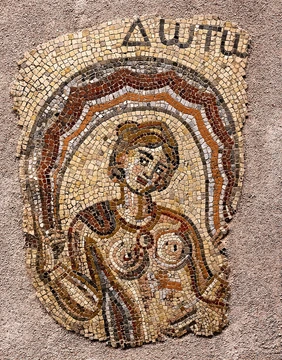
Erechtheus
King of Athens, founder of the polis, and god linked to Poseidon.

Wikipedia / Wikimedia Commons
Erechtheus (Ancient Greek: Ἐρεχθεύς, lit. 'smasher of earth') is a figure in Greek mythology who was a king of Athens and the founder of the polis. In his role as a god, he was attached to Poseidon as 'Poseidon Erechtheus'. The name Erichthonius is carried by a son of Erechtheus, but Plutarch conflated the two names in the myth of the begetting of Erechtheus.
- field
- Greek mythology
- nationality
- Athenian
- known_for
- King of Athens, founder of the polis, associated with Poseidon as Poseidon Erechtheus
- mythological_role
- King and god
- associated_deity
- Poseidon
Lore & Background
In Homer's Iliad, Erechtheus is the son of 'grain-giving Earth', reared by Athena. The earth-born son was sired by Hephaestus, whose semen Athena wiped from her thigh with a fillet of wool cast to earth, by which Gaia was made pregnant. In the contest for patronage of Athens between Poseidon and Athena, the salt spring on the Acropolis where Poseidon's trident struck was known as the sea of Erechtheus.
A second Erechtheus was given a historicizing genealogy as son and heir to King Pandion I of Athens by Zeuxippe. This later king Erechtheus may be distinguished as Erechtheus II. His siblings were Philomela, Procne, Butes and possibly Teuthras. Erechtheus was father, by his wife Praxithea, of sons Cecrops, Pandorus, Metion and of six daughters: Protogeneia, Pandora, Procris, Creusa, Oreithyia and Chthonia. According to Pseudo-Apollodorus, Erechtheus II had a twin brother named Butes who married Erechtheus' daughter Chthonia.
His reign was marked by the war between Athens and Eleusis, when the Eleusinians were commanded by Eumolpus. An oracle declared that Athens' survival depended on the death of one of the three daughters of Erechtheus. In one version it is Chthonia, the youngest, whom he sacrifices. In another, it is both Protogeneia and Pandora, the two eldest, who offer themselves up. In the following battle, Erechtheus won and slew Eumolpus, but then himself fell, struck down by Poseidon's trident.
Reader's Guide
Erechtheus holds a dual significance in Athenian myth and cult: as a legendary king and founder of the polis, and as a god closely identified with Poseidon. The Athenians thought of themselves as Erechtheidai, the 'sons of Erechtheus', indicating his foundational role in their identity. The central gods of the Acropolis of Athens were Poseidon Erechtheus and Athena Polias, and the archaic joint temple built upon the spot identified as the Kekropion was destroyed by the Persian forces in 480 BC and replaced between 421 and 407 BC by the present Erechtheum. That Poseidon and Erechtheus were two names at Athens for the same figure was demonstrated in the cult at the Erechtheum, where there was a single altar, a single priest and sacrifices were dedicated to Poseidon Erechtheus. Walter Burkert observed that 'a Homeric, pan-Hellenic name has been superimposed on an autochthonous, non-Greek name.' The story of Erechtheus also inspired later works, such as Swinburne's classical tragedy Erechtheus published in 1876.
Did You Know?
- Erechtheus is called 'smasher of earth' in Ancient Greek.
- In Homer's Iliad, Erechtheus is the son of 'grain-giving Earth', reared by Athena.
- The salt spring on the Acropolis where Poseidon's trident struck was known as the sea of Erechtheus.
- The Erechtheum on the Acropolis was built between 421 and 407 BC, replacing an earlier temple destroyed by the Persians in 480 BC.
Frequently Asked Questions
Who is Erechtheus in Greek mythology?
He was a legendary king of Athens credited with founding the city-state, and in his divine aspect he was linked to Poseidon under the epithet 'Poseidon Erechtheus.'
How does filicide appear in Erechtheus's myth?
During the contest between Athena and Poseidon over patronage of Athens, an oracle demanded that Erechtheus's three daughters be put to death to secure the city's safety.
Who are the daughters sacrificed in the Erechtheus story?
The victims were his daughters Praxithea, Procris, and Hecabe, who were killed as a required offering to protect Athens.
Did Erechtheus kill his daughters willingly or were they forced?
The myth frames it as a paternal act of sacrifice—he ordered or permitted their deaths as the price the gods demanded for Athens' survival.
Why do fans of the filicide canon study the Erechtheus myth?
It stands out as a case where a father enacts the death of his own children not out of madness but as a grim civic duty imposed by divine decree.
More in Filicide in mythology 1-24
Spotted an error? Know more?
This is a living reference — every entry is fact-audited, and reader corrections feed straight into our audit queue. Suggest an edit · See this site's audit record