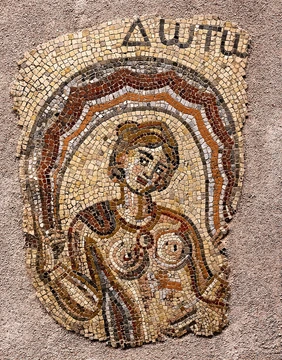
Aëdon
Mourning mother transformed into a nightingale in Greek myth.

Wikipedia / Wikimedia Commons
Aëdon (from the Ancient Greek Ἀηδών, meaning 'nightingale') is a figure in Greek mythology. She was the daughter of Pandareus. In Homer's account, she was married to Zethus and was the mother of Itylus. Two distinct story cycles are associated with Aëdon, one set in Thebes and the other in Western Asia Minor. Both involve the killing of her own child and explain how the nightingale, a bird perpetually in mourning, came to be. In certain versions of her myth, Aëdon is considered a doublet of the Athenian princess Procne.
The noun ἀηδών translates to 'nightingale' and also carries the secondary meaning of 'singer'. It shares its root with the verb ἀείδω, meaning 'to sing, to chant, to praise', which itself comes from the Proto-Hellenic *awéidō, possibly from the Proto-Indo-European root *h₂weyd-.
Aëdon was the daughter of Pandareus and his wife Harmothoë. Her sisters were Cleothera and Merope. According to the geographer Pausanias, the painter Polygnotus replaced the names of the first two sisters with Cameiro and Clytie. Aëdon married either Zethus, king of Thebes, and bore him an only son named Itylus, or Polytechnus, a carpenter from Colophon in Lydia, and bore him an only son named Itys. Some authors also mention a daughter named Neis.
Aëdon's early life began as the daughter of Pandareus, king of Miletus, and his wife Harmothoë. Pandareus stole a golden dog from the temple of Zeus in Crete. After this transgression, Pandareus was killed, leaving Aëdon and her sisters Cleothera and Merope orphans. Aëdon married Zethus, a son of Zeus, and became queen of Thebes. Her sisters were adopted and raised by Aphrodite. When they came of age, Aphrodite went to Zeus to find them suitable husbands. During her absence, either the Winds or the Harpies snatched Cleothera and Merope away and brought them to the Furies to serve as handmaidens. Why Aëdon escaped this fate is unclear.
In the Theban story, Aëdon was the wife of Zethus, one of the twin kings of Thebes. She accidentally killed her own son Itylus when "madness was upon her." This story is very old, referenced in Homer's *Odyssey* when Penelope speaks to Odysseus. Eustathius of Thessalonica and other scholiasts explain that Aëdon was envious of her sister-in-law, Niobe (Amphion's
- mythological_role
- Mortal woman transformed into a nightingale
- family
- Daughter of Pandareus and Harmothoë; wife of Zethus or Polytechnus; mother of Itylus or Itys
- known_for
- Accidental or deliberate filicide; aetiological myth of the nightingale's mournful song
- associated_places
- Thebes; Colophon in Lydia; Ephesus
- alternate_names
- Aēdṓn (Greek); Procne (doublet)
Lore & Background
Aëdon was the daughter of Pandareus, king of Miletus, and his wife Harmothoë. After Pandareus stole a golden dog from the temple of Zeus in Crete, he was killed, leaving Aëdon and her sisters Cleothera and Merope orphans. Aëdon married Zethus, a son of Zeus, and became queen of Thebes. Her sisters were adopted by Aphrodite but later snatched away by the Winds or Harpies to serve the Furies.
In the Theban version, Aëdon intended to kill one of Niobe's sons out of envy for Niobe's many children, but mistakenly killed her own son Itylus instead. According to the Homeric scholiast citing P
Reader's Guide
Aëdon's significance lies in her role as an aetiological figure explaining the nightingale's mournful song. All versions of her story involve the death of her child and her transformation into a bird that laments endlessly. The myth is among the oldest in Greek tradition, referenced as early as Homer's Odyssey, where Penelope compares her own grief to Aëdon's. The story also serves as a doublet for the more famous myth of Procne and Philomela, with which it shares the themes of filicide, revenge, and transformation into birds. Joseph Fontenrose identified five versions of Aëdon's legend, noting structural similarities with the myth of Athamas. The Anatolian variation appears to have originated in etymologies, as it is essentially identical to the Procne-Philomela story. Notably, in reality, only male nightingales sing, whereas the myth attributes the song to the female Aëdon. The myth thus reflects ancient attempts to explain natural phenomena through narrative, while also exploring themes of jealousy, rivalry, and unintended consequences of human actions.
Did You Know?
- Aëdon's name is the Ancient Greek word for 'nightingale' and shares a root with the verb 'to sing.'
- In one version, Aëdon killed her son Itylus after mistaking him for her nephew Amaleus in the dark.
- The myth of Aëdon is referenced in Homer's Odyssey, where Penelope compares her own grief to Aëdon's mourning.
- In reality, only male nightingales sing, but the myth attributes the song to the female Aëdon.
Frequently Asked Questions
Who is Aëdon in Greek mythology?
Aëdon is a mortal woman in Greek myth, identified as the daughter of Pandareus and Harmothoë and the wife of either Zethus or Polytechnus. Her very name is the Ancient Greek word for nightingale, a direct reflection of her fate in the story.
What filicide does Aëdon commit?
Aëdon kills her own son, Itylus (also called Itys), either through a tragic accident or a deliberate act, depending on which version of the tale you read. This act of killing her child is the central catastrophe around which the entire myth revolves.
How does Aëdon's story end?
After her child's death, Aëdon is transformed into a nightingale. In this new form she becomes a bird whose song is an endless, unrelenting expression of grief for the child she lost.
Why is the nightingale's mournful song linked to Aëdon?
Her myth serves as an aetiology, providing a mythological reason for the nightingale's characteristically sorrowful song. The bird's perpetual lament is attributed to Aëdon's inability to stop mourning her slain son.
How does Aëdon relate to the figure of Procne?
In several traditions Aëdon is treated as a doublet of Procne, the Athenian princess from the Tereus–Phoebe cycle. Both share the same core narrative: a mother who kills her child and is then changed into a bird, tying their stories together across different regional myth cycles.
More in Filicide in mythology 1-24
Spotted an error? Know more?
This is a living reference — every entry is fact-audited, and reader corrections feed straight into our audit queue. Suggest an edit · See this site's audit record