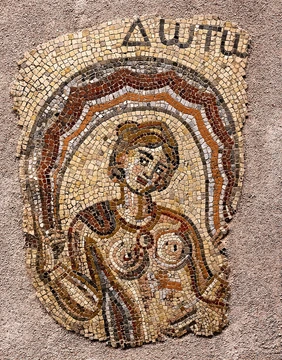
Jephthah
Judge who vowed to sacrifice his daughter after defeating the Ammonites.

Wikipedia / Wikimedia Commons
Jephthah (Hebrew: יִפְתָּח, Yiftāḥ) is a figure from the Book of Judges who served as a judge over Israel for six years (Judges 12:7). He resided in Gilead. The text gives his father’s name as Gilead, and since his mother is described as a prostitute, this may imply that any man from that region could have been his father. Jephthah led the Israelites in war against the Ammonites. Before the battle, he made a vow to God: in exchange for victory, he would sacrifice whatever—or whoever—first came out of his house to greet him upon his return. When his daughter was the first to emerge, he regretted the vow but felt bound by it, and he carried out the sacrifice.
The biblical account of Jephthah appears in Judges chapters 11 and 12. The Israelites had again done evil in the Lord’s sight, forsaking him, so the Lord allowed them to be oppressed by the Philistines and Ammonites. Jephthah, an illegitimate son driven out by his half-brothers, settled in Tob, east of Gilead, where outlaws gathered around him and raided with him. The elders of Gilead later asked him to lead them against the Ammonites. He negotiated for a permanent leadership role, and they agreed that if he succeeded, he would become their chieftain. Jephthah then challenged the Ammonites on behalf of Israel, relying on God’s power. He swore an oath: whatever came out of his house doors to meet him when he returned in peace from the Ammonites would belong to the Lord, and he would offer it as a burnt offering. After his victory, his only child, a daughter, came out to meet him. Jephthah tore his clothes and cried out in distress, but he insisted he could not break his vow. She asked for two months to wander the mountains and weep for her virginity. He granted this, then did to her as he had vowed. The story notes that the daughters of Israel annually lamented Jephthah’s daughter for four days. Later, Jephthah fought the Ephraimites, who had refused to help him against Ammon. The conflict is remembered for the shibboleth test: fugitive Ephraimites were identified by their accent, pronouncing the word as “sibboleth,” and 42,000 were killed. The Epistle to the Hebrews lists Jephthah among distinguished Old Testament figures.
Commentary on the story often contrasts Jephthah’s sacrifice with the Binding of Isaac, where an angel stopped Abraham from sacrificing his son. Some note that the Israelites of that
- field
- Judge of Israel
- nationality
- Israelite
- known_for
- Vow to sacrifice his daughter; defeat of the Ammonites; shibboleth incident with the Ephraimites
- tenure
- Six years
Lore & Background
The traditional tale of Jephthah became part of the Book of Judges (Judges 11–12). The Israelites 'again did what was evil in the sight of the Lord ... they forsook the Lord and did not serve him. So the anger of the Lord was kindled against Israel, and he sold them into the hand of the Philistines and into the hand of the Ammonites ...'. The illegitimate Jephthah, driven out by his half-brothers, took up his dwelling in Tob, east of the land of Gilead. 'Outlaws collected around Jephthah and went raiding with him.' The elders of Gilead ask him to lead them in fighting against the Ammonites, but he holds out for a more permanent and a broader position, and the elders agree that, provided Jephthah succeeds in defeating Ammon, he will be their permanent chieftain. On behalf of Israel as a whole and in reliance on the might of God the Judge, Jephthah challenges the Ammonites. Jephthah swears an oath: 'whatever [footnote: Or whoever] comes out from the doors of my house to meet me when I return in peace from the Ammonites shall be the LORD's, and I will offer it [footnote: Or him] up for a burnt offering' (Judges 11:31, English Standard Version).
Reader's Guide
Jephthah's story is significant for its stark depiction of a rash vow and its tragic fulfillment, contrasting with the Binding of Isaac in Genesis where divine intervention prevented human sacrifice. The narrative highlights the moral decline of Israel during the period of the judges, as some writers observed that the Israelites widely disrespected Mosaic law, which forbade human sacrifice. David Janzen argued that the story was an integral part of the Deuteronomist picture of moral decline through adoption of non-Israelitic practices such as child sacrifice. Solomon Landers believed that the absence of express judgement implies that the sacrifice was not acceptable to God, notwithstanding the fact that the sacrifice nevertheless happened. Later, Jephthah was forced to fight against the Ephraimites, remembered for the killing of fugitive Ephraimites identified by their accent—they said 'shibboleth' as 'sibboleth'—resulting in 42,000 Ephraimites falling. The Epistle to the Hebrews mentions Jephthah in a list of distinguished Old Testament figures. Jewish and Christian commentators have debated whether the vow was fulfilled literally or through perpetual virginity, with some, like Ethelbert William Bullinger, arguing the Hebrew allows for an alternative reading of dedication rather than sacrifice.
Did You Know?
- Jephthah's father's name is also given as Gilead, and his mother is described as a prostitute.
- The story of Jephthah includes the origin of the word 'shibboleth' as a test of pronunciation.
- Pseudo-Philo's Liber Antiquitatum Biblicarum gives a name for Jephthah's daughter: Seila.
- According to some rabbinical commentators, Phineas sinned by failing to relieve Jephthah of his vow.
More in Filicide in mythology 1-24
Spotted an error? Know more?
This is a living reference — every entry is fact-audited, and reader corrections feed straight into our audit queue. Suggest an edit · See this site's audit record