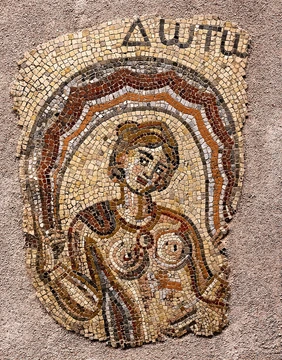
Hyacinthus the Lacedaemonian
Lacedaemonian who sacrificed his daughters to save Athens from famine.

Wikipedia / Wikimedia Commons
Hyacinthus was a Lacedaemonian figure in Greek mythology who is said to have moved to Athens. He is known for having, in compliance with an oracle, caused his four daughters to be sacrificed on the tomb of the Cyclops Geraestus to deliver the city from famine and plague during the war with Minos over the death of Androgeos.
- origin
- Lacedaemonian
- moved_to
- Athens
- known_for
- Father of the Hyacinthides, sacrificed his daughters to end famine and plague
- daughters
- Antheis, Aegleis, Orthaea, Lytaea (per Bibliotheca); Antheis (per Hyginus); Lousia (per Stephanus of Byzantium)
- associated_deities
- Athena or Persephone
Lore & Background
Hyacinthus was a Lacedaemonian who moved to Athens. In compliance with an oracle, he caused his four daughters to be sacrificed on the tomb of the Cyclops Geraestus, for the purpose of delivering the city from famine and the plague under which it was suffering during the war with Minos over the death of the latter's son Androgeos. The daughters were sacrificed either to Athena or Persephone and were known in Attic legends as the Hyacinthides, a name derived from their father.
The names and numbers of the Hyacinthides differ among writers. The author of the Bibliotheca mentions four: Antheis, Aegleis, Orthaea, and Lytaea, while Hyginus only mentions Antheis. One account represents them as married, although they were sacrificed as maidens, whence they are sometimes called simply αἱ παρθένοι. Stephanus of Byzantium calls one of them Lousia, eponym of a demos, Lousia, of the phyle Oineis.
Some traditions conflate the Hyacinthides with the daughters of Erechtheus and relate that they received their name from the village of Hyacinthus, where they were sacrificed at the time when Athens was attacked by the Eleusinians and Thracians, or Thebans. Some traditions further confound them with Agraulos, Herse, and Pandrosus, or with the Hyades. The story of Leos and his daughters is also comparable to that of Hyacinthus and the Hyacinthides.
Reader's Guide
Hyacinthus is a minor but significant figure in Greek mythology, primarily known as the father of the Hyacinthides, whose sacrifice was central to Athens' deliverance from famine and plague. The story reflects themes of oracular obedience, filial sacrifice, and civic salvation, common in Attic foundation myths. The varying accounts of the daughters' names and numbers—ranging from one to four, with different names in different sources—illustrate the fluidity of oral and literary traditions. The conflation of the Hyacinthides with other mythological groups, such as the daughters of Erechtheus, Agraulos, Herse, Pandrosus, and the Hyades, shows how myths could merge over time. The story's parallels with that of Leos and his daughters further situate it within a broader pattern of sacrificial narratives in Athenian lore. Hyacinthus's legacy is preserved primarily through these daughters, whose name became a toponym for a village and a deme, linking myth to Athenian geography and civic identity.
Did You Know?
- Hyacinthus was a Lacedaemonian who moved to Athens.
- His four daughters were sacrificed on the tomb of the Cyclops Geraestus to end famine and plague.
- The daughters were known as the Hyacinthides, a name derived from their father.
- Some traditions conflate the Hyacinthides with the daughters of Erechtheus or with Agraulos, Herse, and Pandrosus.
Frequently Asked Questions
Who is Hyacinthus the Lacedaemonian?
Hyacinthus is a Spartan-origin figure in Greek mythology who is said to have relocated to Athens. He is remembered primarily as the father of the Hyacinthides, the group of daughters he was compelled to kill as a ritual offering.
What were the names of Hyacinthus's daughters?
The Bibliotheca gives four names—Antheis, Aegleis, Orthaea, and Lytaea—while Hyginus mentions only Antheis and Stephanus of Byzantium records a daughter called Lousia. The exact roster shifts depending on which ancient source you consult.
Why did Hyacinthus sacrifice his daughters?
An oracle commanded him to lay his four daughters on the tomb of the Cyclops Geraestus as the required price to lift the famine and plague strangling Athens. The crisis was entangled with the hostilities against Minos that followed the killing of Androgeos, and the offering was the prescribed remedy.
Which deity is Hyacinthus's story connected to?
Ancient traditions link the episode either to Athena or to Persephone, and the oracle that ordered the sacrifice serves as the narrative bridge between the father's act and divine will. No single source fixes the association definitively.
Why does Hyacinthus the Lacedaemonian matter in discussions of mythological filicide?
His narrative presents a father who kills his own children not from hatred but from obedience to a divine command intended to save an entire city. It is one of the sharpest examples in Greek myth of filicide reframed as a tragic civic obligation rather than a personal transgression.
More in Filicide in mythology 1-24
Spotted an error? Know more?
This is a living reference — every entry is fact-audited, and reader corrections feed straight into our audit queue. Suggest an edit · See this site's audit record