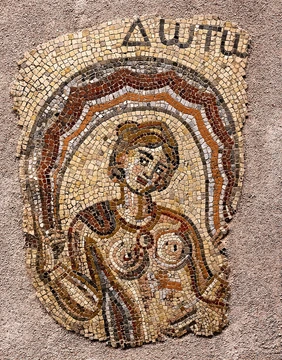
Ino (mythology)
Theban princess who became the sea goddess Leucothea.

Wikipedia / Wikimedia Commons
Ino (EYE-noh; Ancient Greek: Ἰνώ) was a Theban princess who later became queen of Boeotia. After her death and transformation, she was worshipped as a goddess under the name Leucothea, meaning "the white goddess." The poet Alcman referred to her as "Queen of the Sea," which, if not an exaggeration, places her as a deity comparable to Amphitrite.
Ino was the second daughter of King Cadmus and Queen Harmonia of Thebes. She was one of three sisters of Semele, the mortal woman who gave birth to Dionysus. Her only brother was Polydorus, another ruler of Thebes. Along with her sisters Agave and Autonoë, Ino served as a surrogate and divine nurse to Dionysus, described as a primordial Dionysian woman and a divine maenad. She became the second wife of the Minyan king Athamas, mother of Learchus and Melicertes, and stepmother of Phrixus and Helle.
In the story behind Jason and the Golden Fleece, Ino hated her stepchildren Phrixus and Helle. She devised a plot to destroy them by roasting all the crop seeds of Boeotia so they would not grow. Fearing famine, local farmers consulted an oracle. Ino bribed the messengers to falsely report that the oracle demanded Phrixus’s sacrifice. Athamas reluctantly agreed, but before the killing, a flying golden ram sent by the twins’ natural mother, Nephele, rescued them. Helle fell off the ram into the Hellespont and drowned, but Phrixus reached Colchis, where King Aeetes welcomed him and gave him his daughter Chalciope in marriage. In gratitude, Phrixus gave the king the Golden Fleece, which Aeetes hung in a tree.
Later, Ino raised her nephew Dionysus, causing Hera’s intense jealousy. In revenge, Hera struck Athamas with madness. He killed his son Learchus, hunting him like a stag, then pursued Ino. To escape, Ino threw herself into the sea with her son Melicertes. Both were afterwards worshipped as marine divinities: Ino as Leucothea, Melicertes as Palaemon. In another version, Ino herself went mad, boiled Melicertes in a cauldron, then jumped into the sea with his dead body. A sympathetic Zeus transfigured them into Leucothea and Palaemon. In rare accounts, Ino killed Melicertes after discovering Athamas was sleeping with a slavewoman named Antiphera.
Ino’s tragic end mirrored that of her siblings: Semele died pregnant with Zeus’s child, killed by her own pride; Agave killed her son King Pentheus in Dionysian madness; and Act
- born
- Thebes (mythological)
- died
- Threw herself into the sea (mythological)
- field
- Greek mythology
- nationality
- Theban / Boeotian (mythological)
- known_for
- Second wife of Athamas, stepmother of Phrixus and Helle, nurse of Dionysus, later deified as Leucothea
Lore & Background
Ino was the second daughter of King Cadmus and Queen Harmonia of Thebes, and one of the three sisters of Semele, the mortal woman who gave birth to Dionysus. Her only brother was Polydorus. Together with her sisters Agave and Autonoë, they were the surrogates and divine nurses of Dionysus. Ino was the second wife of the Minyan king Athamas, mother of Learchus and Melicertes, and stepmother of Phrixus and Helle.
In the back-story to Jason and the Golden Fleece, Ino hated her stepchildren Phrixus and Helle. She roasted all the crop seeds of Boeotia so they would not grow, then bribed men sent to an oracle to lie that the oracle required the sacrifice of Phrixus. Athamas reluctantly agreed, but Phrixus and Helle were rescued by a flying golden ram sent by their natural mother, Nephele. Helle fell off the ram into the Hellespont and drowned, but Phrixus survived to Colchis, where he gave King Aeetes the Golden Fleece.
Later, Ino raised Dionysus, causing Hera's intense jealousy. In vengeance, Hera struck Athamas with insanity. Athamas slew his son Learchus, hunting him like a stag, and pursued Ino. To escape, Ino threw herself into the sea with her son Melicertes. Both were afterwards worshipped as marine divinities: Ino as Leucothea, Melicertes as Palaemon. Alternatively, Ino was also stricken with insanity and killed Melicertes by boiling him in a cauldron, then jumped into the sea with her dead son. A sympathetic Zeus transfigured them. In rare versions, Ino killed Melicertes when she found Athamas sleeping with a slavewoman.
Reader's Guide
Ino's significance lies in her dual role as a mortal queen and a deified sea goddess. As Leucothea, she appears in Homer's Odyssey (5:333 ff), providing divine aid to Odysseus by giving him a veil and instructing him how to entrust himself to the waves and reach the island of Scheria. This is her earliest appearance in literature. Her story is also part of a larger tragic pattern among the children of Cadmus and Harmonia: Semele died while pregnant with Zeus' child, Agave killed her own son Pentheus, and Actaeon was torn apart by his own dogs. The insanity of Ino and Athamas is explained as a result of their contact with Dionysus, whose presence can cause madness. In historical times, a sisterhood of maenads of Thebes in the service of Dionysus traced their descent in the female line from Ino, as attested by an inscription at Magnesia on the Maeander that summoned three maenads from Thebes, from the house of Ino, to direct new mysteries. Festivals called Inoa were celebrated in many places in her honor.
Did You Know?
- Ino was the second daughter of King Cadmus and Queen Harmonia of Thebes.
- She was the stepmother of Phrixus and Helle and plotted to have Phrixus sacrificed.
- After throwing herself into the sea with her son Melicertes, she was worshipped as the goddess Leucothea.
- In Homer's Odyssey, Ino-Leucothea aids Odysseus by giving him a veil and instructing him how to reach land.
Frequently Asked Questions
Who is Ino in the context of filicide in mythology?
Ino was a Theban princess who, as stepmother of Phrixus and Helle, attempted to murder both children in a fit of madness. She stands as a prominent example in Greek myth of a parental figure turning lethal violence toward a child under her care.
What exactly did Ino do to Phrixus and Helle?
Driven mad, Ino tried to kill her stepchildren, but Phrixus was rescued by a divine golden-wooled ram sent by their mother Nephele. Helle, however, slipped from the ram's back mid-flight and drowned in the strait that now bears her name, the Hellespont.
Why did Ino try to kill her stepchildren?
The myth points to a combination of divine punishment—Hera drove Ino to madness for nursing the infant Dionysus—and her own jealousy toward the children of Athamas's first wife, Nephele. Her resentment and the goddess's curse together pushed her to lethal violence.
How does Ino's story end after the attempted filicide?
Following Helle's death and the later loss of her own son Melicertes to the sea, Ino cast herself into the ocean. She was then deified as Leucothea, 'the white goddess,' and received cult worship as a sea deity.
Is Ino's act technically filicide or something else?
Because Phrixus and Helle were her stepchildren rather than biological offspring, the act is more precisely a stepmother's attempted murder of stepchildren. Scholars nonetheless include it under the broader umbrella of parental killing of children in mythological taxonomy.
More in Filicide in mythology 1-24
Spotted an error? Know more?
This is a living reference — every entry is fact-audited, and reader corrections feed straight into our audit queue. Suggest an edit · See this site's audit record