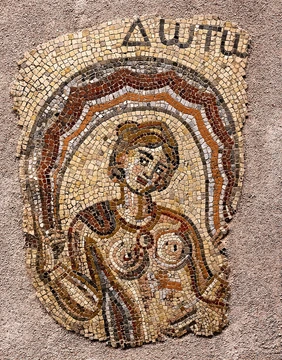
Tantalus
Mythological figure punished with eternal hunger and thirst in Tartarus.
Tantalus (Ancient Greek: Τάνταλος, romanized: Tántalos), also called Atys, was a Greek mythological figure most famous for his punishment in Tartarus. He was made to stand in a pool of water beneath a fruit tree with low branches, with the fruit ever eluding his grasp and the water always receding before he could drink. This punishment, though best-known today, was a more unusual detail in surviving early Greek sources, where variants including a stone suspended above his head are more commonly recorded. The ancient Greeks used the proverb 'Tantalean punishment' in reference to people with nice things who are unable to experience them, and his name and punishment are the source of the English word tantalize.
- known_for
- Punishment in Tartarus: standing in a pool of water beneath a fruit tree with low branches, with fruit and water ever receding; also a stone suspended above his head
- field
- Greek mythology
- nationality
- Greek (associated with Lydia, Phrygia, and Paphlagonia in Asia Minor)
- father
- Zeus (or Tmolus in a few sources)
- mother
- Pluto
- children
- Pelops, Niobe, Broteas (and Dascylus according to a scholium)
Lore & Background
Tantalus was generally said to be a son of Zeus and a woman named Pluto, though in a few sources Tmolus is given as the father. The identity of his wife is variously given: generally as Dione the daughter of Atlas; Euryanassa, daughter of Pactolus; Clytia, child of Amphidamantes; and Eupryto. He was the father of Pelops, Niobe, and Broteas, and through Pelops he was the progenitor of the House of Atreus, which was named after his grandson Atreus and which was plagued by misfortune, making the house the subject of many Greek tragedies. There may have been a historical Tantalus, possibly the ruler of an Anatolian city named 'Tantalís' or 'Sipylus'. Pausanias reports that there was a port under his name and a sepulcher of him 'by no means obscure' in the same region. Near Mount Sipylus are archaeological features that have been associated with Tantalus and his house since Antiquity, including a tholos 'tomb of Tantalus' and a 'throne of Pelops'.
Reader's Guide
Tantalus's significance lies primarily in his punishment, which became a proverbial and linguistic touchstone. The ancient Greeks used the proverb 'Tantalean punishment' for people with nice things who are unable to experience them, and the English word 'tantalize' derives from his name and punishment, meaning to torment with the sight of something desired but out of reach. The oldest surviving reference to Tantalus is in the Odyssey, where Odysseus sees him in Hades standing in a pool of water beneath a fruit tree. The crime for which this is the punishment is not mentioned in the Odyssey. The earliest account of his crime is found in a fragment of the lost Nostoi: Tantalus asked to be allowed to live like the gods, and Zeus, bound by an oath, granted this but placed a giant rock above his head so that fear of the rock falling prevented him from ever enjoying the banquet. In other surviving early Greek sources, the stone perpetually hanging above Tantalus's head is the more popular variant. The variant in which Tantalus attempts to feed the gods his dismembered son appears comparatively late in the surviving sources, though it is clearly familiar to audiences by the time of Pindar. Pindar, in his first Olympian Ode, rejects this version, implying it is a lie and relating a different account in which Tantalus invited the gods to a meal and Poseidon carried off Pelops. The rock of Tantalus was also used as a proverbial expression by Pindar and Archilochus, in the same vein as the Sword of Damocles, to suggest being unable to enjoy something because attempting to do so places one in a position of perpetual imminent peril.
Did You Know?
- The English word 'tantalize' derives from Tantalus's name and punishment, meaning to torment with the sight of something desired but out of reach.
- The oldest surviving reference to Tantalus is in the Odyssey, where Odysseus sees him in Hades standing in a pool of water beneath a fruit tree.
- In some early Greek sources, the more common variant of Tantalus's punishment was a stone suspended above his head, not the receding food and water.
- Pindar, in his first Olympian Ode, rejects the story that Tantalus served his son Pelops to the gods, calling it a lie.
More in Filicide in mythology 1-24
Spotted an error? Know more?
This is a living reference — every entry is fact-audited, and reader corrections feed straight into our audit queue. Suggest an edit · See this site's audit record