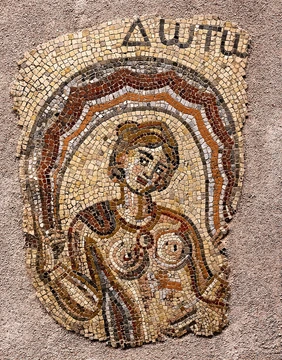
Leos (mythology)
Attic eponym and herald whose daughters were sacrificed.

Wikipedia / Wikimedia Commons
Leos is a figure from Greek mythology, appearing as one of the ten or twelve Eponyms of the Attic phylae, whose statues stood in the Athenian agora near the Tholos. He is also known as a herald from the deme of Agnus in Attica who betrayed the sons of Pallas to Theseus.
- known_for
- Eponym of an Attic phyle; father of sacrificed daughters; herald who betrayed the Pallantids
- field
- Greek mythology
- nationality
- Attic (Greek)
- notable_events
- Sacrifice of his daughters to relieve famine; betrayal of the sons of Pallas
Lore & Background
Leos, son of Orpheus, was one of the ten or twelve Eponyms of the Attic phylae, with statues at the Athenian agora near the Tholos. He had a son, Cylanthus, and three daughters: Praxithea (or Phasithea, Phrasithea), Theope, and Eubule. In obedience to a Delphian oracle, he had his three daughters sacrificed to relieve the city of famine. A location in Attica and a hero-shrine were said to have received the name Leokorion (or Leocorion) after these daughters, though the story may have been invented to explain the placename.
Another Leos, a native of Agnus, Attica, served as the herald of the sons of Pallas. He betrayed them by informing Theseus of their imminent attack, allowing Theseus to strike while they were unaware and win. Because of this betrayal, no intermarriage occurred between the demes Agnus and Pallene, and Pallenian heralds never used the formula "ἀκούετε λεῷ" ("Listen, people") due to the homophony of the word leōs ("people") and Leos' name. The people of Agnus, on the contrary, sacrificed to Leos.
Reader's Guide
Leos appears in Greek mythology in two distinct roles, both tied to Attic cult and civic identity. As an eponymous hero of an Attic phyle, his statue in the agora marked his importance in the tribal organization of Athens. The story of his daughters' sacrifice, though possibly invented to explain the place name Leokorion, reflects themes of familial sacrifice for communal welfare common in Greek myth. The second Leos, a herald from Agnus, illustrates how myth could encode social prohibitions: his betrayal of the Pallantids led to enduring taboos on intermarriage between demes and on a heraldic formula. These narratives show how mythological figures were used to explain local customs, place names, and political boundaries. The ambiguity over whether the daughters' story is aetiological underscores the fluidity between myth and historical explanation in ancient sources.
Did You Know?
- Leos was one of the ten or twelve Eponyms of the Attic phylae, with statues in the Athenian agora near the Tholos.
- He had three daughters—Praxithea (or Phasithea, Phrasithea), Theope, and Eubule—whom he sacrificed on the advice of the Delphian oracle to end a famine.
- The place name Leokorion (or Leocorion) was said to derive from these daughters, though the story may have been invented to explain the name.
- A different Leos, a herald from Agnus, betrayed the sons of Pallas to Theseus, leading to a ban on intermarriage between the demes Agnus and Pallene.
More in Filicide in mythology 1-24
Spotted an error? Know more?
This is a living reference — every entry is fact-audited, and reader corrections feed straight into our audit queue. Suggest an edit · See this site's audit record